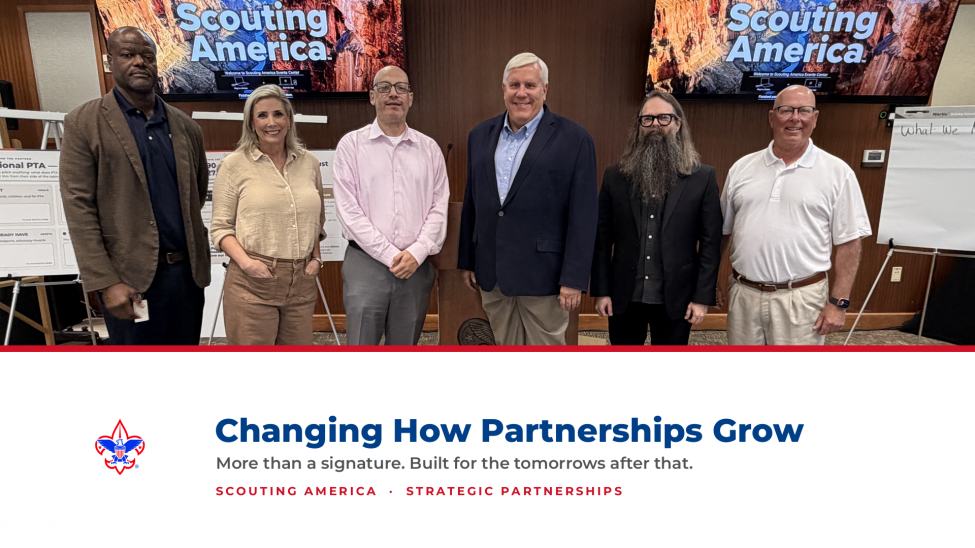
Changing How Partnerships Grow
By Corilynn Bailey | Director of Strategic Youth Partnerships, Scouting America
This week I sat in two rooms that reminded me why I do this work.
Not a webinar. Not a status update. Two rooms with real people in them, doing the harder and far more valuable thing: figuring out together what our young people actually need, and what each of us is genuinely able to do about it.
THE FIRST ROOM
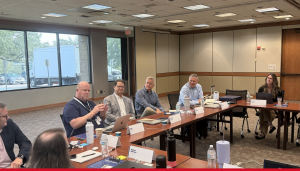
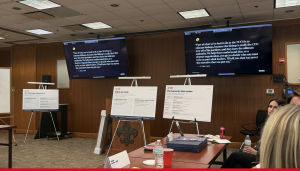
We came together to ask a direct question: how do we make an extraordinary impact on youth through Scouting in the Catholic faith — not only for the young people in front of us today, but for tomorrow, and the tomorrows after that?
- National Catholic Educational Association
- United States Conference of Catholic Bishops
- National Catholic Committee on Scouting
- Gloo Marketing
- Scouting America executive leadership and internal teams, including Chief Executive Officer Roger Krone
That last detail is worth pausing on. Sessions where the most senior person present is a delegate tend to produce recommendations. Sessions where the decision-maker sits through the whole day produce decisions. Having Roger in the room for the duration told every partner there exactly how seriously we take this work.
What made the session work was not the agenda. It was the willingness to get back to basics to name plainly what matters most to both organizations, where our missions genuinely overlap, and what it will take to reach a young person in a parish, a school, and a troop as one connected experience rather than three separate ones.
That kind of clarity does not come from a deck. It comes from people who trust each other enough to say the honest thing out loud.
THE SECOND ROOM
We also spent time with the National PTA, reviewing the work already happening between our councils across the country and local PTAs, and asking what becomes possible if two youth-serving organizations stop working in parallel and start working in concert.
Dr. Bill Datema, National PTA’s President, and Howie Berman, MA, CAE, its Executive Director, joined us along with senior leaders from both organizations. Two people who can actually move an institution, spending a day at the same table. That changes the character of a conversation. Nobody has to take anything back for approval before they can be honest about it.
The overlap is significant, and it centers on something both of us understand: no child is served well by one institution acting alone. PTA has spent more than a century insisting that families belong at the center of a child’s education. Scouting has spent more than a century building character, leadership, and service through hands-on experience outside the classroom. One strengthens the school day. The other strengthens everything around it. Together they reach the whole child and, just as importantly, the whole family.
A partnership is not a document. It is a set of relationships strong enough to outlast the people who signed it.
WHY THIS IS DIFFERENT
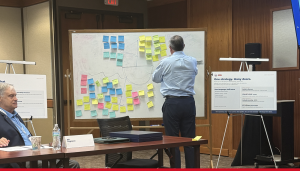
Here is what I have observed across nonprofit and corporate partnerships alike: too many of them are conducted as presentations. Two organizations sit across a table, each takes a turn projecting slides at the other, everyone nods, someone signs something, and the relationship is declared complete.
That is not collaboration. That is not even learning. It is an exchange of information neither party retains, and it quietly becomes nothing at all.
Real collaboration requires something more uncomfortable and far more productive. It requires listening, actually listening, with the willingness to change your plan because of what you heard. It requires both parties naming what they cannot do as honestly as what they can. And it requires designing for a horizon well beyond the current fiscal year.
That is the shift underway at Scouting America. We are not pursuing signatures. We are building partnerships intended to serve young people for decades, and that means investing in the relationships, the shared understanding, and the mutual respect that make the paperwork almost incidental.
WHAT WE ARE ACTUALLY BUILDING
When a national partner and Scouting America truly align, a young person does not experience two programs. They experience one continuous message about who they are capable of becoming, reinforced at church, at school, at home, and around a campfire.
That consistency is what forms character. It is also what almost no single organization can deliver alone.
Which is precisely why the room matters more than the memorandum.
To every partner who gave us their time, their candor, and their genuine belief in what young people are capable of this week: thank you. You made these sessions what they were.
The work ahead of us is significant. I could not be more grateful to be doing it alongside you.
Prepared. For Life.®

reach out