What Sextortion Offenders Hope Young People Never Hear
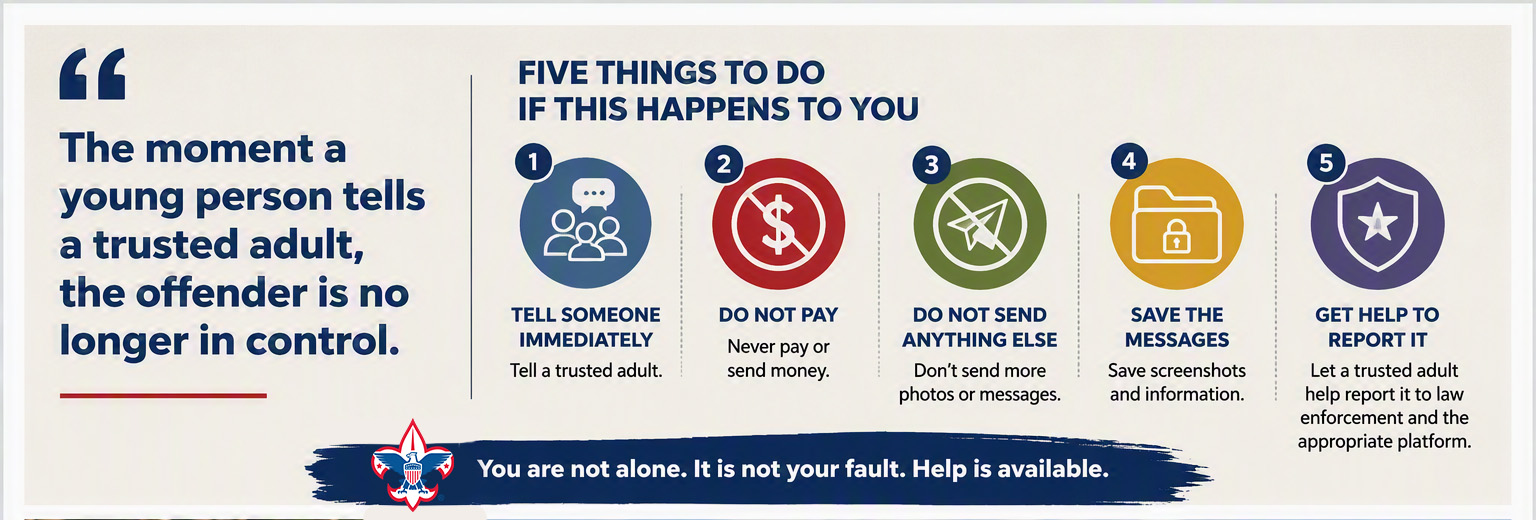
“The moment a young person tells a trusted adult, the offender is no longer in control.”
Guest article from Scouting America Chief Safeguarding Officer Glen Pounder
Having served in law enforcement for three decades, and for several years afterwards working to combat child exploitation, there is not much in this space that surprises me. I have seen offenders adapt, technologies change, and familiar crimes find new ways to reach children. But sextortion still stands out, not only because of the harm it causes, but because in many cases, the most powerful prevention message is also the simplest one.
Sextortion is an unusual child exploitation crime type because, once a young person understands what is happening and knows they can ask for help, the offender’s power begins to collapse. The crime relies on fear. It relies on shame. It relies on a child believing that one mistake, one image, one moment of panic, has somehow ended their life as they know it. That is the lie the criminals sell, and it is the lie we must break.
The power of telling a trusted adult
This was brought home to me again this summer at the Scouting America Jamboree. A 14-year-old Scout was targeted online in a sextortion attempt while attending the event. The offender was likely hundreds, if not thousands, of miles away, using a screen to create fear.
Thankfully, and importantly, the Scout did exactly the right thing. He told his dad, who was also there.
I met with them afterwards, and I told him that a Scout is brave and that I was proud of him. His dad was sitting there, and maybe it might have sounded unusual coming from someone else, but it was exactly what I felt. In that moment, he had done the hardest and most important thing: he had taken the offender’s power away by telling a trusted adult.
I have thought about that conversation several times since. It reminded me that bravery in these cases does not always look dramatic. Sometimes it is a frightened young person finding the courage to walk over to a parent and say, “I need help.”
Why fear works
So why does this crime continue to increase? The National Center for Missing and Exploited Children has reported sharp growth in financially motivated sextortion, with reports rising from more than 36,000 in 2024 to more than 50,000 in 2025.
Those numbers are staggering, but they do not tell the full human story. Behind each report is a child who may have been sitting alone in a bedroom, at school, at camp, or somewhere that should have felt safe, suddenly being told that their image will be sent to family, friends, classmates, teammates, or everyone they know unless they pay money or send more images.
Part of the increase reflects organized criminal groups exploiting this crime at scale. They are not confused teenagers making poor decisions online. They are criminals who understand how children communicate, where they spend time, and how quickly panic can be created. They harvest young people online almost like shoals of fish, moving rapidly from friendly contact to sexualized conversation, then to an image, and then to threats. The playbook is well understood. The language may vary, the platform may change, but the pressure is familiar: “Pay now,” “Send more,” “I will ruin your life,” “Everyone will know.”
What adults must get right
That is why adults need to talk about this before a crisis happens. If the first time a child hears the word sextortion is after an offender is threatening them, we are already late. Young people need to know in advance that these schemes exist, that the offender is committing the crime, and that asking for help is the right next step. They also need to hear it without a lecture attached. A child who is terrified does not need a speech about online judgement in that moment. They need an adult who can stay calm, take control, preserve evidence, report the matter, and remind them that this can be handled. The Scout at the Jamboree did not need shame added to fear; he needed calm, support and a clear message that he had made the right choice.
That also means the adults around a child need to be ready for the disclosure. We cannot currently control every message a young person receives, and we cannot pretend that risk disappears because a child is at a Scouting event, at home, or surrounded by adults who care about them. Online harm travels with the device, and technology companies do not always appear to have children’s safety at the front of their minds. What we can control is the culture around disclosure.
If a young person believes the first adult response will be anger, humiliation, or punishment, the offender’s threats become more convincing. If they believe the first response will be calm help, the offender has far less power.
We should also be honest about something very practical: some young people may stay silent because they fear losing their phone or being cut off from their friends more than they fear the offender. That may seem frustrating to adults, but it is real. If our first message is “I’ll take your phone away,” we may unintentionally make the offender’s threat more powerful. The immediate priority has to be safety, evidence, and support.
We also need to be careful about fear-based prevention messages. I still hear of school presentations where children are told that sending an image is a crime. The intention may be prevention, but young people are not stupid. They usually already know it is wrong, risky, or at least something they desperately wish they had not done. In a sextortion situation, a message built mainly around criminality can make silence more likely, not less. The child may hear, “I am in trouble too,” when what they most need to hear is, “Tell someone now; we can help.”
The message young people need before a crisis
The fear, and sometimes the panic, this creates has in too many cases led to children dying by suicide. Brandon Guffey lost his son Gavin in these tragic circumstances in 2022; he has since led a campaign of education and awareness. He also agreed to share his story in our Safeguarding Youth Training.
For me, that was done with one aim: that every child hears this message clearly. If you make a mistake online, including sharing an intimate image of yourself, it is just that, a mistake. We will get through it. The only people who should be afraid are the criminals trying to scare you, because the good men and women of law enforcement will do all they can to identify them and bring them to justice.
That message matters because victims often think they have no good option. They may believe paying will make the problem go away. It rarely does. They may believe sending one more image will buy time. It usually gives the offender more leverage. They may believe deleting the conversation will make it disappear. It can make it harder for investigators to follow the trail.
The better response is simple: stop communicating, do not pay, do not send anything else, save what you can, tell a trusted adult immediately, and report it to law enforcement and the appropriate technology platform.
Parents and leaders also have a role in removing the fear ahead of time. We should tell young people plainly that if someone threatens them online, they will not be alone and they will not be abandoned to deal with it themselves. We should be careful not to create such a fear of getting in trouble that a child decides silence is safer than disclosure. Accountability and learning can come later. In the urgent moment, safety comes first.
We also must remember that this crime can move incredibly quickly. It can begin on a gaming platform, a messaging app, a social media account, or anywhere young people communicate. It may involve a fake profile, a stolen image, or someone pretending to be another teen. Increasingly, criminals move conversations to private or encrypted channels because they know it makes detection harder. None of that should make us fatalistic. It should make us practical. The prevention message does not need to be complicated to be effective.
The line I want every young person to remember is this: the offender’s strongest weapon is your fear. Take that fear away by telling someone. Once an adult knows, once law enforcement can be engaged, once the platform can be reported to, the criminal no longer controls the situation in the same way. The child may still be frightened, embarrassed, or angry with themselves, but they are no longer alone with the offender’s threats.
Sextortion is cruel because it turns a young person’s fear against them. Our answer has to be direct, repeated, and believable.
- Tell someone immediately.
- Do not pay.
- Do not send anything else.
- Save the messages.
- Let a trusted adult help report it.
Most importantly, young people need to hear this before anything happens: you are not the criminal, this can be dealt with, and there are adults who know exactly what to do next. If we make that message louder than the offender’s threats, we have a real chance to save lives.
“The moment a young person tells a trusted adult, the offender is no longer in control.”

reach out